When you see the Roman numerals XXV and XXVIII, you’re looking at the numbers 25 and 28, respectively, symbolizing not just quantities but milestones steeped in history. XXV often marks a quarter-century milestone, while XXVIII connects to lunar cycles and completeness. Both have roots in ancient Rome’s practical numbering but also carry cultural weight in documents, celebrations, and symbolism. As you explore further, you’ll uncover their deeper historical and cultural layers.
Key Takeaways
- XXV represents the number 25, symbolizing milestones and achievements like silver jubilees in various cultures.
- XXVIII equals 28, often linked to lunar cycles and themes of completeness and renewal.
- Both numerals originate from ancient Rome, historically used in calendars, military records, and legal documents.
- XXV and XXVIII evoke concepts of time’s passage, balance, and cultural heritage through their numerical structure.
- Common confusion arises between XXV and XXVIII, but remembering their composition (25 as two tens plus five, 28 as two tens plus eight) aids accuracy.
What Do Roman Numerals XXV and XXVIII Represent in Arabic Numbers?

Roman numerals like XXV and XXVIII serve as a historical numbering system that you can decode by understanding their individual components. Each letter corresponds to a specific value: X equals 10, V equals 5, and I equals 1. In XXV, you see two Xs followed by a V. The two Xs add up to 20, and the V adds 5, totaling 25. For XXVIII, the two Xs again represent 20, but this time you add a V and three Is. The V contributes 5, while the three Is add 3 more, summing to 28. By analyzing each symbol and their order, you grasp the precise value behind XXV and XXVIII, appreciating the logical structure that underpins this ancient numeric system. Additionally, understanding the evolution of photography highlights how different cultures have used symbols and numbers to convey meaning through time.
Converting XXV and XXVIII to Arabic Numerals
To convert XXV and XXVIII into Arabic numerals, you first need to understand the values each Roman numeral represents. You’ll apply a method that adds or subtracts these values based on their order within the numeral. By working through practical examples, you’ll see exactly how these conversions unfold step by step. Additionally, understanding film characteristics can enhance your creative expression as you explore numerals in various contexts.
Roman Numeral Basics
Understanding the basics of numeral conversion helps you decode the values behind XXV and XXVIII efficiently. Roman numerals use letters to represent numbers, with I, V, X, L, C, D, and M symbolizing 1, 5, 10, 50, 100, 500, and 1,000 respectively. You read numerals from left to right, adding or subtracting values depending on their order. For example, when a smaller numeral precedes a larger one, you subtract; otherwise, you add. In XXV, two X’s (10 each) followed by V (5) means you add 10 + 10 + 5 to get 25. XXVIII extends this by adding three I’s (1 each) after V, so you sum 10 + 10 + 5 + 1 + 1 + 1, resulting in 28. This foundation prepares you to understand more complex Roman numeral patterns.
Converting Method Explained
One effective approach to converting numerals like XXV and XXVIII into Arabic numbers involves analyzing each character sequentially while applying addition and subtraction rules. You start by identifying the value of each Roman numeral letter—X equals 10, V equals 5, and I equals 1. Then, you compare each symbol with the next one to decide whether to add or subtract its value.
Keep these steps in mind:
- Read from left to right, noting each numeral’s value.
- If a smaller value precedes a larger one, subtract it.
- Otherwise, add the values together.
- Sum all adjusted values to get the final Arabic number.
Practical Conversion Examples
Although Roman numerals might seem complex at first, converting XXV and XXVIII into Arabic numbers becomes straightforward once you apply the systematic rules. Take XXV: each X equals 10, and V equals 5. You add these values—10 + 10 + 5—resulting in 25. For XXVIII, break it down similarly: X (10) + X (10) + V (5) + I (1) + I (1) + I (1). Adding these together, you get 10 + 10 + 5 + 1 + 1 + 1, totaling 28. By analyzing each symbol’s value and summing them sequentially, you grasp how Roman numerals translate. This practical approach helps you quickly convert similar numerals, reinforcing your understanding of their structure and enhancing your ability to interpret historical or decorative numbering accurately.
Where Do XXV and XXVIII Come From?
You’ll find that XXV and XXVIII originate from the ancient Roman system of numerals, which used combinations of letters to represent values. Understanding their historical usage reveals how Romans organized numbers for trade, architecture, and record-keeping. This context helps you grasp why these numerals have endured through time. The cultural significance of Roman numerals can be seen in their continued use in modern contexts, such as clock faces and book chapters.
Origins of Roman Numerals
Roman numerals like XXV and XXVIII trace their roots to ancient Rome’s numeric system, which relied on combinations of letters from the Latin alphabet to represent values. You’ll find these numerals emerged from practical needs in trade, record-keeping, and construction. The system’s design hinges on additive and subtractive principles, where letters stand for fixed amounts, combined to form numbers. Understanding their origins gives insight into their structure:
- I, V, X, L, C, D, M represent 1, 5, 10, 50, 100, 500, and 1000 respectively
- Numerals form by adding values when letters decrease left to right
- Subtractive notation appears when smaller values precede larger ones
- This system reflects early Rome’s emphasis on clarity and efficiency in communication
Historical Usage Explained
Understanding the origins of Roman numerals sets the stage for exploring how specific numbers like XXV (25) and XXVIII (28) played roles in historical contexts. You’ll find these numerals frequently marking important dates, such as the 25th and 28th days of months on ancient Roman calendars. They also appeared in military records to denote legion numbers—Legio XXV or Legio XXVIII—highlighting organizational structure in Roman armies. Additionally, inscriptions on monuments and coins often used these numerals to signify regnal years or significant events. By analyzing these uses, you can see how XXV and XXVIII weren’t arbitrary; they functioned as precise markers in civic, military, and religious life. This detailed historical application reflects the numerals’ practical importance beyond mere counting, grounding them firmly in Roman culture and administration.
Historical Uses of XXV and XXVIII in Documents and Monuments
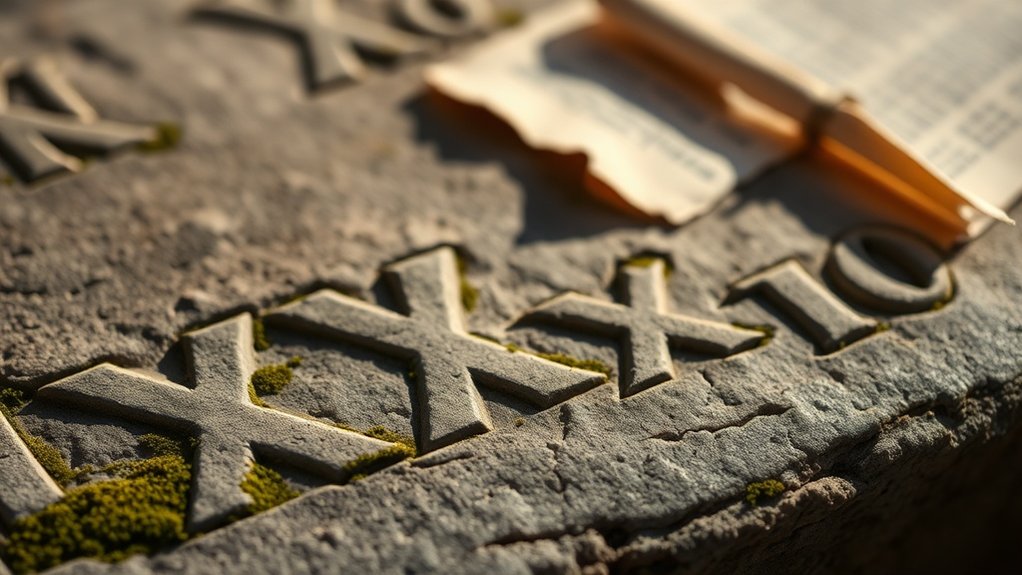
Numerals like XXV and XXVIII have long served as more than mere numbers; they act as markers of time, authority, and significance within historical documents and monuments. When you examine these numerals, you uncover layers of context reflecting chronological records or hierarchical distinctions. For instance, XXV often marks the 25th year of a ruler’s reign, while XXVIII might indicate important legislative acts or anniversaries.
Consider these historical uses:
- Inscribed on monuments commemorating 25 or 28 years of significant events
- Embedded in charters validating legal or royal authority
- Used in dating manuscripts or treaties to specify years precisely
- Marking sequential lists, such as the 25th or 28th item in official records
These applications reveal how XXV and XXVIII helped you interpret time and legitimacy in historical contexts. Additionally, the use of such numerals in documents often reflected hierarchical distinctions that were crucial for understanding the authority of the text.
Symbolic Meanings of Roman Numerals XXV and XXVIII
While XXV and XXVIII have historically marked specific years or items, their use extends beyond practical notation to carry symbolic weight. You’ll find XXV, representing 25, often symbolizes milestones—like a quarter-century—evoking themes of maturity, achievement, and change. XXVIII, or 28, carries layered meanings; it’s linked to lunar cycles and completeness, signifying renewal and rhythm. When you interpret these numerals symbolically, you see they embody concepts of time’s passage and cyclical nature. Their structure, combining multiples of ten and five, also hints at balance and progression. By understanding this, you appreciate how these numerals communicate more than quantity; they evoke cultural ideas about growth, cycles, and accomplishment embedded in historical and symbolic contexts. This makes XXV and XXVIII potent symbols beyond mere numbers. Additionally, the way photography captures and preserves significant moments resonates with the symbolism of these numerals, as it ensures memories endure, connecting individuals to their roots and enriching the lives of descendants.
Modern Uses of XXV and XXVIII

Many contemporary contexts incorporate XXV and XXVIII to convey significance beyond their numerical value. When you encounter these numerals today, they often serve as markers of milestones or symbols embedded in design, branding, and commemorations. You’ll notice their deliberate use to evoke tradition, prestige, or exclusivity. For example, XXV (25) and XXVIII (28) frequently appear in:
Roman numerals like XXV and XXVIII symbolize tradition and prestige in modern design and commemorations.
- Event anniversaries signaling longevity or achievement
- Limited edition product labels emphasizing rarity
- Sports jerseys to honor player numbers or championship years
- Film and literature titles adding a classical or timeless tone
Additionally, the strategic use of visual content in marketing can enhance the impact of these numerals, making them resonate more deeply with audiences.
Cultural Significance of XXV and XXVIII Worldwide
Beyond their modern applications, XXV and XXVIII carry rich cultural meanings that vary across regions and traditions. When you encounter XXV, you’re seeing the number 25, often symbolizing milestones like silver jubilees or significant anniversaries in many cultures. XXVIII, representing 28, holds significance in contexts such as lunar calendars, where 28 days mark a full cycle, influencing rituals and timekeeping worldwide. You’ll notice that in some cultures, these numerals appear in ceremonial dates or inscriptions, embedding historical or spiritual importance. Understanding this, you realize these numbers do more than count; they connect you to collective memories and temporal rhythms. By appreciating their cultural contexts, you gain insight into how numerical symbols transcend mere arithmetic to embody identity and tradition globally. Additionally, their significance in various celebrations often reflects the emotional engagement tied to cultural heritage, marking pivotal moments in communal history.
Common Mistakes When Reading and Writing XXV and XXVIII
Understanding the common mistakes when reading and writing XXV and XXVIII can prevent confusion and errors, especially in formal or academic contexts. You might misinterpret XXV (25) as XXVIII (28) due to their similar structure, leading to inaccurate data or miscommunication. Often, people confuse the subtractive and additive principles of Roman numerals, causing errors in conversion. Also, overlooking the importance of the placement of “I”s after “V” in XXVIII can lead to wrong readings. Watch for these typical pitfalls:
Recognizing common errors with XXV and XXVIII avoids confusion and ensures accurate interpretation of Roman numerals.
- Mistaking XXV for XXVIII by ignoring the three additional “I”s
- Confusing the value of “V” as 10 instead of 5
- Misordering numerals, such as writing XVIII instead of XXVIII
- Assuming all numerals follow subtractive notation rules
Being aware of these errors sharpens your accuracy. Additionally, practicing regular shooting schedules can help enhance your understanding of numeral structures through consistent engagement.
Tips for Remembering and Using XXV and XXVIII Correctly
Recognizing common mistakes in reading and writing XXV and XXVIII sets a foundation for accurate usage. To remember these numerals correctly, break them down: XXV is 10 + 10 + 5, totaling 25, while XXVIII adds three I’s after the V, making it 28. Visualize XXV as two tens plus a five, and XXVIII as two tens plus eight units. Practice writing them side by side, noting how the extra I’s distinguish 28 from 25. Also, associate XXV with the quarter-century mark and XXVIII with dates or events featuring the number 28. By contextualizing these numerals through patterns and meaning, you’ll reduce errors and confidently use them in historical, mathematical, or formal settings. Understanding composition techniques can also enhance your ability to represent numerical concepts visually in your work.
Frequently Asked Questions
Are XXV and XXVIII Used in Modern Mathematics or Science?
You won’t find XXV and XXVIII commonly used in modern math or science since Arabic numerals dominate for clarity and efficiency, but you might see them in specific contexts like clock faces, outlines, or historical references.
Can XXV and XXVIII Represent Anything Besides Numbers?
Can XXV and XXVIII represent more than numbers? Absolutely, you’ll find them symbolizing dates, chapters, or even anniversaries, providing context beyond math—transforming simple numerals into meaningful markers in literature, history, or events.
How Do XXV and XXVIII Influence Art and Design Today?
You’ll find XXV and XXVIII inspire minimalist and vintage designs, adding classical elegance. Designers use these numerals to evoke timelessness and sophistication, influencing typography, branding, and art by blending historical depth with modern aesthetics.
Are There Famous People Associated With XXV or XXVIII?
You’ll find no famous people directly tied to XXV or XXVIII, but these numerals often mark significant dates or milestones linked to notable figures, subtly influencing historical contexts and artistic tributes in culture and media.
Do XXV and XXVIII Appear in Popular Movies or Literature?
You’ll spot XXV and XXVIII like hidden gems in movies or literature, often marking dates or titles. Their Roman numeral charm adds gravitas, enriching historical or epic stories, subtly connecting you to time’s ancient pulse.